


Great Minds
Architects of thought · Masters of the inner world

Gilbert Ryle
Gilbert Ryle (1900–1976) was a prominent British philosopher, best known for his critique of Cartesian dualism. He was a leading f…
Explore →
Ernst Nolte
German historian who ignited the 1986 Historikerstreit with a single provocative thesis: that the Nazi Holocaust was a defensive r…
Explore →
Umberto Eco
Italian semiotician and novelist who gave fascism studies its most widely circulated diagnostic tool: the concept of Ur-Fascism. I…
Explore →Roger Griffin
British political theorist who reoriented fascist studies around a single definitional core: palingenetic ultranationalism. His 19…
Explore →
Robert Paxton
Robert Paxton is the historian who dismantled the search for a fixed fascist ideology and replaced it with a dynamic, five-stage m…
Explore →
Giovanni Gentile
Giovanni Gentile built the philosophical architecture of Italian fascism. His system, 'actual idealism,' held that reality is noth…
Explore →
Benito Mussolini
Benito Mussolini gave fascism its name, its symbol, and its most explicit doctrine: the totalitarian state as an absolute. In 'The…
Explore →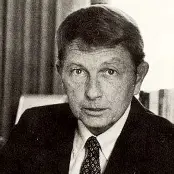
Duane P. Schultz
Duane P. Schultz was an American psychologist and a leading historian of psychology whose textbooks defined the field for generati…
Explore →Edwin Garrigues Boring
Edwin Garrigues Boring was an American psychologist and a preeminent historian of psychology. His magnum opus, 'A History of Exper…
Explore →
Ayn Rand
Ayn Rand built Objectivism, a philosophical system that grounds laissez-faire capitalism in rational self-interest rather than eco…
Explore →
Ludwig von Mises
Ludwig von Mises is the economist who demonstrated that a socialist economy cannot rationally allocate resources because it lacks …
Explore →
Karl Polanyi
Karl Polanyi argued that the self-regulating market was not a natural development but a historically contingent and socially destr…
Explore →